


 English
 عربى
عربى Français
 Español
 Português
Cable tray straight adopts a coverless U-shaped straight section design, and the overall structure is simple and practical. Its core structure is a U-shaped trough, and the edges on both sides are des...
READ MOREData Center Cable Management Solutions: Cable Trays for Efficient Power Routing
Data centers face a constant challenge: keeping hundreds of power, data, and fiber cables organized, protected, and cool enough to run reliably. In many facilities, messy cable runs contribute to overheating, airflow blockage, installation delays, and maintenance headaches. The most effective solution is a well-designed cable tray system that supports every run from the inlet to the server rack. This article explains what to look for, how different tray types compare, and how a manufacturer with real project experience can help you build a long-term, serviceable cable management layout.
Why Cable Management Matters in a Data Center
A defined cable route is not optional in a modern data center. High-density cabinets, hot-aisle containment, and continuous operations demand that every cable has a predictable path. When trays are specified correctly, they keep power and low-voltage cables physically separate, preserve airflow between racks, and make future changes easier. Poorly planned routing, on the other hand, leads to cable sag, unintended load on equipment, and service interruptions during routine work.
In practice, cable management decisions affect more than tidiness. A tray that is too shallow will be overloaded before the facility reaches capacity. A tray with small fittings will create bottlenecks at every turn. A tray without the right surface treatment will corrode in high-humidity environments. These are the risks that show up after commissioning, not during the drawing review.
If you are designing a new greenfield site, the tray specification is one of the first things the mechanical and electrical engineer will lock down. If you are retrofitting an existing facility, the challenge is fitting new trays into occupied spaces without disturbing live cables. Both scenarios call for careful selection of tray depth, width, and accessory dimensions. Even a small mismatch can force the installer to bend sheet metal on site, which delays the schedule and compromises the coating.
Choosing the Right Cable Tray System for Data Centers
The most common tray formats used in data centers are wire mesh, cable ladder, and cable trunking. Each has a distinct trade-off between airflow, load capacity, and protection. Choose based on the cable types you carry and the space you have above or below the floor.
Wire Mesh Cable Tray
Wire mesh trays are popular in data centers for their open structure and easy field adjustment. The mesh lets air pass around bundles, which helps maintain cabinet inlet temperatures. They are also lighter than solid trays and can be installed in tight overhead spaces. However, they require careful support spacing because they are not intended for very heavy power cables.
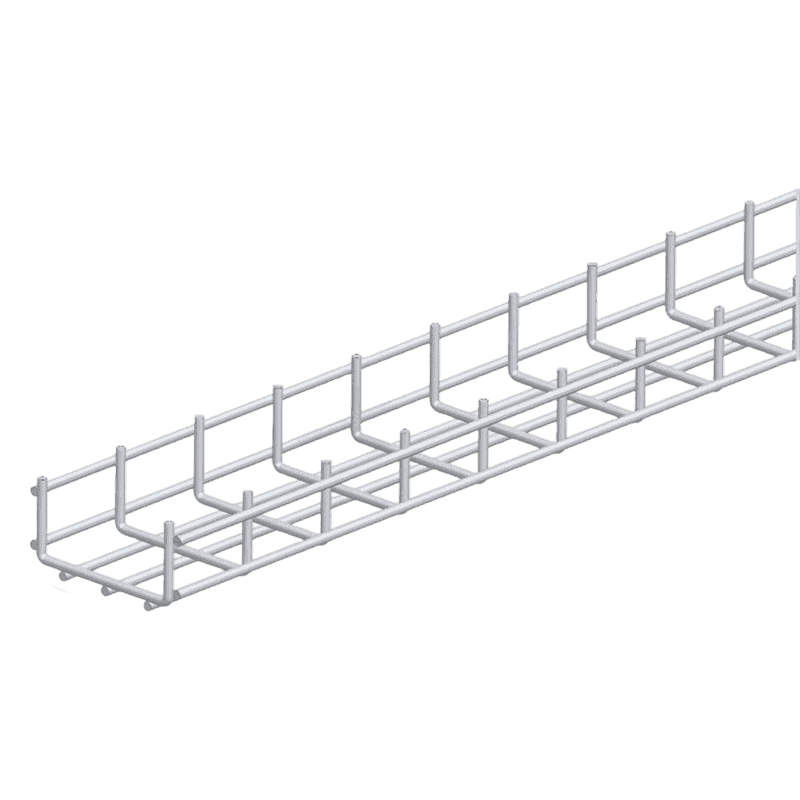 Wire Mesh Cable Tray for Data Center CablingThis open-grid tray offers high visibility and easy rerouting, ideal for data centers. Its design allows airflow to maintain cabinet temperatures, but requires careful support spacing for heavy loads.View Product →
Cable Ladder
Cable ladders offer high load capacity for larger power and fiber runs. Their rungs provide continuous support with less friction than flat surfaces, making long pulls easier. In a data center, ladders are often used for the main power feed from the utility room to the distribution cabinets. Their strong side rails accommodate heavier loads and longer spans, reducing the number of overhead supports needed.
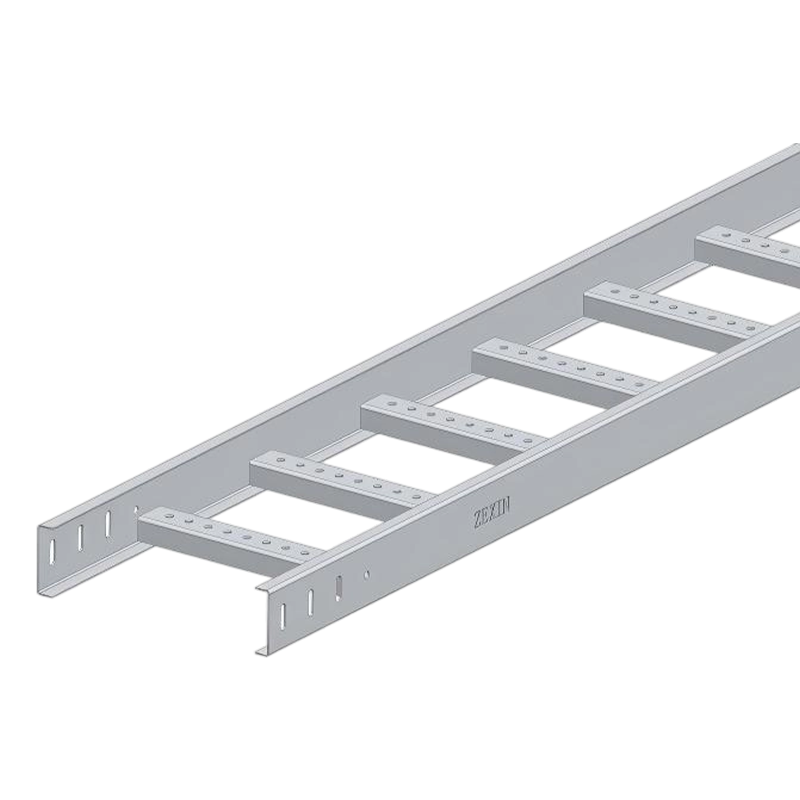 High-Capacity Cable Ladder for Heavy Power RunsThis ladder tray supports up to 200 kg/m, making it suitable for large power and fiber runs. Its open structure promotes heat dissipation, and strong side rails reduce the need for frequent supports.View Product →
Cable Trunking
Cable trunking provides a closed, dust-resistant path. It gives a cleaner appearance and helps contain small wires that might otherwise hang loose. In areas where cable containment is required for safety or environmental reasons, trunking is a practical choice. It can be fitted with covers and used for both horizontal and vertical routing.
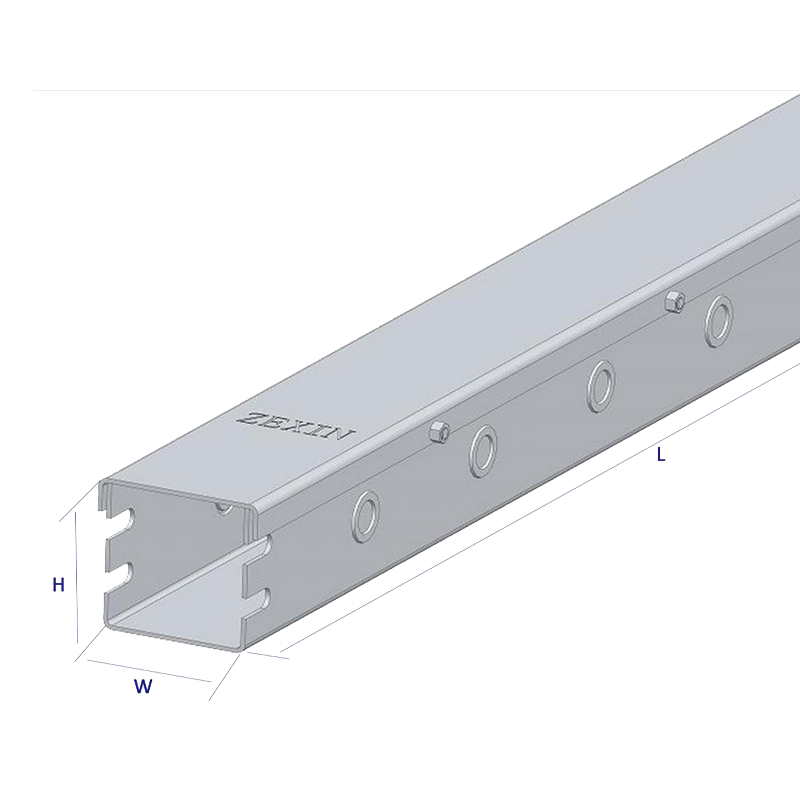 U-Shaped Cable Tray with Optional CoverThis straight tray provides a simple U-channel for cable support, with side fixing holes for easy connection. It can be used with covers to protect against dust, fitting various indoor and outdoor applications.View Product →
Material and Surface Treatment Considerations
Data center environments are typically air-conditioned, but humidity can still be a problem, especially in the air intake areas. For indoor applications, cold-rolled steel with a hot-dip galvanized or powder-coated finish provides good corrosion resistance at a moderate cost. For raised-floor or outdoor installations, stainless steel is an option. FRP (fiberglass) trays are resistant to many chemicals and are useful in battery rooms or industrial sites, but they are less common in standard white spaces.
It is important to confirm the coating thickness and the edge treatment. Sharp edges can damage cable insulation during pulling. A manufacturer that uses automated forming and secondary polishing, like the process we follow in our factory, reduces this risk and keeps the surface consistent across large orders.
The finish also influences compatibility with other metal parts. If you use hot-dip galvanized trays with stainless steel supports, you may create galvanic corrosion under certain conditions. A practical approach is to standardize the material throughout the system, or at least to consult the supplier about mixed materials. Our factory can match the finish to the project specification and verify the coating thickness before shipment.
Installation Planning and Cable Routing
Once the tray type is selected, the next step is planning the route. Start from the main distribution area and work toward each row or cabinet. Where possible, run trays in straight segments and use elbows, tees, and crosses to change direction or split branches. Reducers help transition between different tray sizes. These accessories turn a collection of trays into a continuous system.
A practical rule is to leave 20-30 percent spare capacity for future additions. Also think about access: covers should be removable or liftable at junctions, and supports should be placed where they can be maintained. In projects like our own data center work, we supplied complete fitting sets to avoid on-site improvisation and cutting.
When setting the support spacing, consider the tray type and the cable load. Wire mesh needs more frequent supports than a heavyweight ladder. In a raised floor environment, cable trays can be mounted on brackets or suspended from the ceiling. The key is to use the designed support intervals without adding stress to the tray flanges. A complete bending schedule for the route can minimize the number of field modifications.
Real-World Example: MY06 Phase II Data Center
For a real-world illustration, consider the MY06 Phase II data center project. In that facility, we supplied cable trays that supported power distribution and communication runs in a structured layout. The project required consistent dimensions, reliable delivery, and close coordination with the installation team. It demonstrated how a manufacturer that understands data center workflows can help contractors stay on schedule and on budget.
Working with a Manufacturer for Customized Solutions
Data center projects vary in rack layout, ceiling height, and load requirements. That is why a flexible manufacturer matters. We offer standard and custom manufactured trays, including OEM/ODM production based on your drawings. If you are a contractor or local distributor handling a specific facility, we can help you confirm specifications, supply matching accessories, and plan shipping to the site. Contact us through our contact page to discuss your project requirements.
As a cable tray manufacturer based in China with export experience to Southeast Asia, Africa, and South America, we understand the importance of container loading and packing. We prepare trays in nesting bundles, protect edges, and provide fitting sets in labeled crates. This reduces the unpacking time on site and prevents missing parts. You can also request a pre-shipment inspection or sample approval before the final production run.
Cable management is an investment that pays back in uptime, safety, and speed of maintenance. Choosing the right tray type, considering the environment, and using proper fittings are three decisions that can make or break a data center build. With the right supplier by your side, you can build a system that is clean, flexible, and ready for the next generation of equipment.
Related Products
-
-
Cable ladder straight adopts a ladder-type main beam structure with crossbar support. This structure is derived from the mechanical principle of traditional I-beams. The main beam bears the weight of ...
READ MORE -
The core design of the cable ladder reducer is a trapezoidal gradual transition structure. The structure adopts a ladder-type bridge beam body, and the bottom is supported by a crossbar to ensure the ...
READ MORE -
Cable ladder cross adopts a cross-reinforced structural design. This structure achieves uniform distribution of bridge force through precise alignment of the four-way crossbars. Each crossbar is on th...
READ MORE
Related News
-
1.Choosing the Right Cable Trunking Type Cable trunking systems are solutions used to protect cables and ensure their sa...
READ MORE -
Introduction to Wire Mesh Cable Trays What are Wire Mesh Cable Trays? A wire mesh cable tray, also called a wire cable t...
READ MORE -
The Role of Perforated Cable Tray in Solar Power System Wiring Understanding Perforated Cable Trays and Their Functional...
READ MORE -
Cable Trunking: A Key Component in Reducing Electrical Hazards Electrical installations are an essential part of any mod...
READ MORE
Customized service
Customized service
Customized service
Customized service

Telephone consultation
The consultation form is here.
+86-182-6255-8899Working hours 8:00~17:00
-
Address
No. 67 Yongsheng Line, Yangzhong City, Jiangsu Province, China
XIN ZEXIN ELECTRIC PTE LTD
Email: sales@xinzexin.com.sg
Contact: +65 6214 6888
Address: 1 Sunview Road, #03-22 Eco-Tech@Sunview, Singapore 627615 -
E-mail
sales@zexinelectric.com
-
Friendship Link
www.zexin.com
-
Social Media Account
We welcome you to visit and inspect our company on site. Looking forward to becoming your partner.
CONTENTS
Copyright 2025 JIANGSU ZEXIN ELECTRIC TECHNOLOGY CO.,LTD. All Rights Reserved
