


 English
 عربى
عربى Français
 Español
 Português
Cable tray straight adopts a coverless U-shaped straight section design, and the overall structure is simple and practical. Its core structure is a U-shaped trough, and the edges on both sides are des...
READ MOREAluminum Cable Tray Coating Guide: What Should You Use in Harsh Environments?
During a plant expansion review, a project engineer asked whether bare aluminum cable tray would survive in a process building where alkaline fumes drift into the cable route from a caustic dosing area. That question appears on nearly every electrical specification for chemical plants, water treatment facilities, and marine installations. The short answer is that aluminum tray needs no supplementary coating for most indoor and outdoor exposures. Once the environment turns caustic, however, the most dependable option is a PVC-coated aluminum tray, while anodizing offers the best overall balance of corrosion resistance, hardness, and service life for broad industrial use.
Aluminum Cable Tray Is Usually Left Uncoated for a Good Reason
Bare aluminum is the default material for a large share of cable support systems because the metal protects itself. Oxygen exposure produces a thin, dense aluminum oxide film that reforms immediately after scratches or cuts. This self-healing behavior gives 6061-T6 aluminum tray a practical service life of decades in dry indoor environments and moderate outdoor atmospheres, which is why NEMA VE 1 and IEC 61537 classify aluminum as corrosion-resistant without an applied finish.
The oxide film stays stable in the pH range of roughly 4 to 9. In that range, bare aluminum has a real advantage over painted steel: a scratch through a powder coating on steel starts corrosion under the film, while a scratch on aluminum simply re-oxidizes. For ordinary factories, commercial buildings, data centers, and most roof-mounted solar projects, bare aluminum is the technically sound and economical specification. For ventilated indoor runs, a perforated cable tray straight section in bare 6061-T6 aluminum is the most common default because it combines structural strength, heat dissipation, and natural oxide protection in one product.
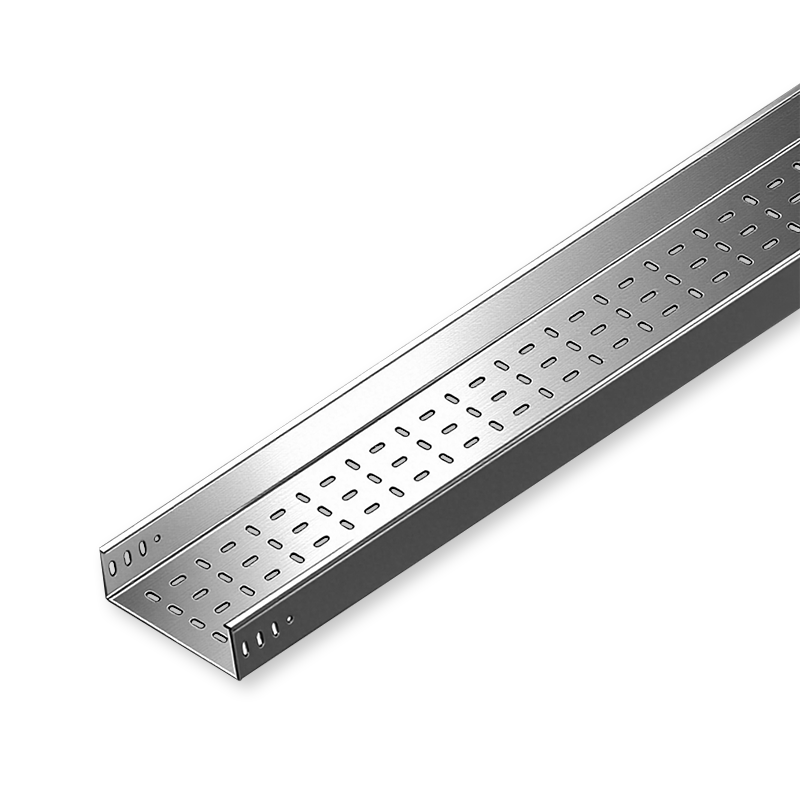 Wholesale Perforated cable tray straight Factory, Manufacturers - Jiangsu Zexin Jiangsu Zexin Electric Technology Co., Ltd is China Perforated cable tray straight manufacturers and factory,Perforated cable tray straig...View Product →
When the Environment Demands a Coating
Coating becomes a requirement, not an option, when the atmosphere falls outside aluminum's passive pH range or when chlorides are present at high concentration.
Caustic atmospheres are the most critical case. Alkalis attack aluminum directly: the protective oxide dissolves quickly above pH 9, and the metal corrodes at a significant rate. Cement plants, detergent production lines, pulp and paper facilities, and water treatment buildings where lime or sodium hydroxide is handled are typical examples. In these zones, the aluminum surface must be isolated from the atmosphere, and PVC coating is the finish most commonly specified for that duty.
Marine and coastal exposure is the second driver. Airborne salt deposits cause pitting on bare aluminum over time; anodizing, or PVC in severe splash zones, extends the service life noticeably. Aluminum is also anodic to most other metals in tray systems, so in wet conditions it can suffer galvanic corrosion wherever it contacts stainless steel hardware or steel supports. Coated contact surfaces and insulating washers are the standard mitigation.
In our experience supplying tray systems for chemical, pharmaceutical, and utility projects, the coating decision is almost never based on indoor humidity. It is based on pH, chloride concentration, and the presence of process chemicals. Where continuous chemical splash defeats any metallic tray, many engineers skip coated aluminum and run FRP cable tray straight sections through the process zone, transitioning to aluminum outside it.
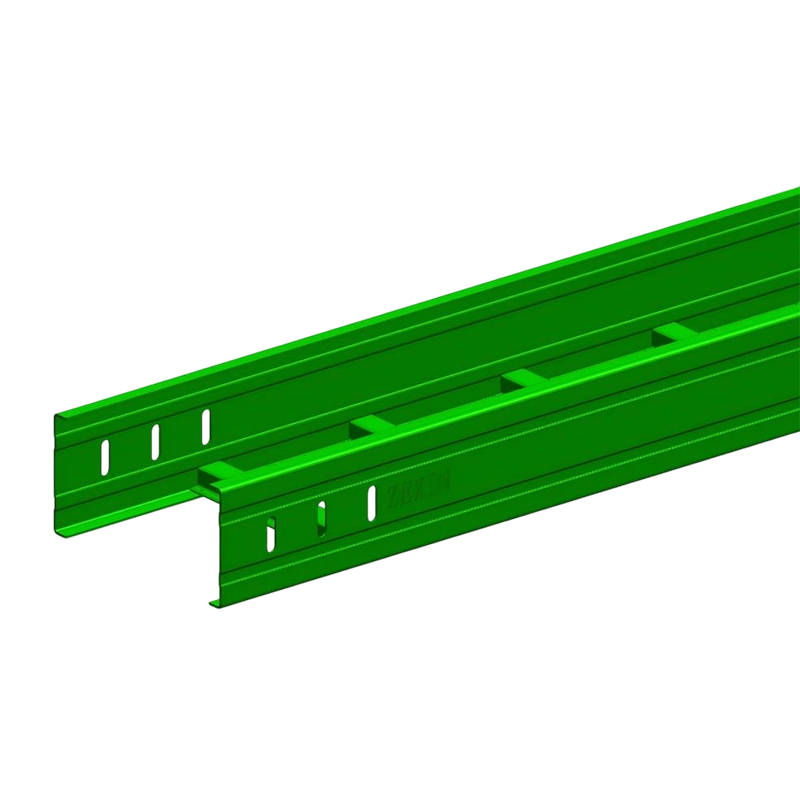 Wholesale FRP cable tray straight Factory, Manufacturers - Jiangsu Zexin ElectriJiangsu Zexin Electric Technology Co., Ltd is China FRP cable tray straight manufacturers and factory,The main material of FRP cable tray...View Product →
Coating Options That Work on Aluminum Cable Tray
The practical question, what should aluminum cable tray be coated with, usually has one of four answers.
PVC Coating: The Standard for Caustic Environments
PVC coating is applied by pretreating the aluminum, heating the tray, and dipping it into a fluidized PVC bed or a plastisol bath. The cured layer is normally 0.3 to 0.5 mm thick, enough to bridge small handling scratches and resist attack from dilute acids and most alkalis. This is why PVC is the accepted coating in caustic process areas.
The trade-offs are temperature and fire behavior. Continuous service above about 60°C softens PVC, and in a fire the coating produces dense smoke and hydrogen chloride gas, so PVC-coated tray is a poor choice for escape routes and plenum spaces. The coating is also soft enough to be cut by sharp cable edges, so field-cut ends must be repaired with a compatible PVC compound.
Anodizing: The Aluminum-Specific Finish
Anodizing grows a thick oxide layer from the aluminum surface itself during an electrochemical bath, so it cannot peel or chip. Type II sulfuric anodizing at 8 to 25 microns is standard for general outdoor service; Type III hard coat at 25 to 75 microns is used where abrasion resistance matters. The anodized layer resists salt air and industrial atmospheres well and is easy to clean.
Anodizing is the right choice when mechanical wear is a concern and the specification needs a finish that stays intact for the life of the installation. It is not the right choice inside aggressive alkali environments, because very high pH will eventually dissolve the oxide layer.
Powder Coating: For Appearance and Indoor Durability
Powder coating deposits polyester or epoxy resin on the aluminum surface and cures it in an oven. Epoxy offers better chemical resistance but poor ultraviolet stability; polyester is less chemical-resistant but lasts better outdoors. Film thickness is normally 60 to 120 microns, with a smooth finish available in custom colors.
The main limitation is edge and corner coverage. The Faraday cage effect causes powder to deposit more thinly on edges and internal corners, exactly the areas most vulnerable to impact. A hard knock during installation can crack the film where it is thinnest, exposing aluminum that then behaves like bare metal. Powder coating therefore fits visually exposed, sheltered locations better than aggressive chemical service.
Epoxy or Zinc-Rich Paint: Only for Touch-Up
Field repairs and cut edges need a compatible touch-up: an epoxy mastic or a two-part polyamide epoxy paint rated for aluminum. Cold galvanizing compounds and zinc-rich primers are a mistake on aluminum because zinc creates a galvanic couple with aluminum in the presence of moisture. Where aluminum tray bolts to steel frames, use stainless steel hardware and insulating washers instead of relying on paint alone.
Coating Comparison at a Glance
The table below summarizes the coating choices, what each finish does well, and where it can create problems.
| Finish | Typical thickness | Best suited for | Main limitation |
|---|---|---|---|
| None (bare 6061-T6) | Natural oxide, 2-5 nanometers | Dry indoor plants, data centers, moderate outdoor air | Attacked by strong alkali and heavy chloride exposure |
| PVC dip coating | 0.3-0.5 mm | Caustic process areas, acid fumes, wash-down zones | Softens above 60°C; smoke emission in fire |
| Anodizing Type II / Type III | 8-25 microns / 25-75 microns | Marine air, outdoor industrial, abrasive handling | Weak against very high pH and continuous immersion |
| Powder coating | 60-120 microns | Indoor visual areas, color-coded cable management | Thin edge coverage; chips under impact |
| Epoxy paint touch-up | 100-250 microns per coat | Cut edges, field repairs, mixed-metal joints | Not a full-tray substitution on its own |
Specification Pitfalls with Coated Aluminum Tray
Getting the finish right is only half the job. Several practical mistakes turn a well-chosen coating into a maintenance problem.
- Do not treat the coating as a grounding conductor. PVC and powder coatings are dielectrics, so a fully coated tray joint can break the equipotential bond. Specify bare contact points under bolts or add copper bonding jumpers at every section joint.
- Cut edges are the first failure point. A PVC-coated tray that is cut or drilled in the field has exposed aluminum at the cut edge. Every field cut needs its edge re-protected with the specified repair compound before installation continues.
- Do not assume anodizing resists everything. It is an oxide, not a barrier like PVC; aggressive alkalis and continuous immersion will still attack it.
- Never use zinc-rich primers on aluminum. The zinc-to-aluminum couple accelerates corrosion of the aluminum whenever moisture reaches the interface.
- Check the finish adhesion on the actual tray profile, not a flat sample. Roll-formed edges, rung welds, and cutouts stress the coating differently, and a finish that looks good on a flat coupon can fail at a radius.
A Practical Selection Sequence
Before the finish is chosen, the tray type has to be fixed. Long spans with heavy power cables point to an aluminum cable ladder straight section, while fine cable runs inside existing buildings usually use perforated or sheet tray. The finish is then applied to whichever format the route demands. Follow this sequence when you sit down to specify the coating:
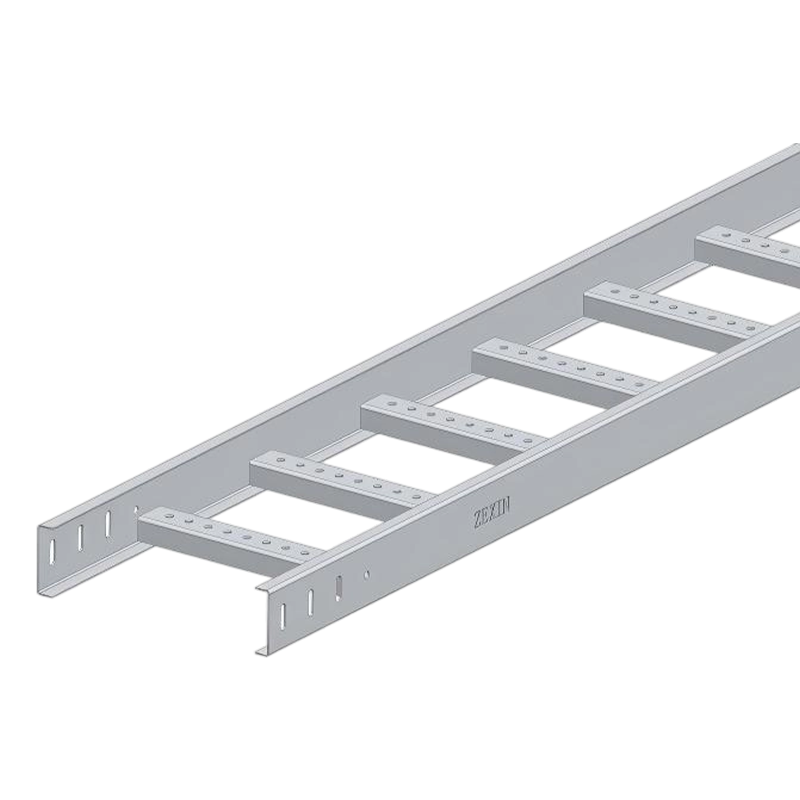 Wholesale Cable ladder straight Factory, Manufacturers - Jiangsu Zexin Electric Jiangsu Zexin Electric Technology Co., Ltd is China Cable ladder straight manufacturers and factory,Cable ladder straight adopts a ladder...View Product →
- Identify the pH range and chemical list of the process atmosphere. If pH falls outside 4 to 9, or alkali fumes are present, choose PVC-coated aluminum or an FRP alternative.
- Assess the chloride load. Coastal sites and roads with de-icing salts mean anodizing or PVC, not bare aluminum.
- Confirm the surface temperature along the tray route. Above 60°C, PVC is off the table and anodizing becomes the better metallic choice.
- Define grounding continuity requirements and coordinate bonding details at coated joints before fabrication.
- Verify the building fire classification. Avoid PVC in plenum spaces and egress routes unless the project specifies a fire-retardant grade.
- Approve a field-cut edge repair method in the contract documents so installers are not improvising on site.
If in doubt, the technically safe defaults are bare 6061-T6 aluminum for dry indoor exposure, anodizing for outdoor air with salt or industrial pollution, and PVC for wash-down or caustic areas.
The coating decision should not be left to a local fabricator after contract award. Coating shops apply PVC with very different thickness and adhesion quality, and anodizing plants are limited by tank size, so not every tray length can be processed. Confirm the finish specification before fabrication, review a sample of the coated profile, and check how the manufacturer seals cut ends and drilled holes.
If you are working on a chemical plant, water treatment facility, or coastal installation and need a finish that will survive years of service, contact our engineering team with the atmosphere details and we will recommend the coating class, thickness, and joint treatment. The right answer to what an aluminum cable tray should be coated with is always the same: enough protection for the specific chemical load at the tray surface, and nothing more than that.
Related Products
-
-
Cable ladder straight adopts a ladder-type main beam structure with crossbar support. This structure is derived from the mechanical principle of traditional I-beams. The main beam bears the weight of ...
READ MORE -
Conservation cable tray straight is made of high-quality cold-rolled steel and aluminum alloy as the main materials. Cold-rolled steel provides a solid support foundation for the bridge with its good ...
READ MORE -
The core design of the cable ladder reducer is a trapezoidal gradual transition structure. The structure adopts a ladder-type bridge beam body, and the bottom is supported by a crossbar to ensure the ...
READ MORE
Related News
-
1.Choosing the Right Cable Trunking Type Cable trunking systems are solutions used to protect cables and ensure their sa...
READ MORE -
Introduction to Wire Mesh Cable Trays What are Wire Mesh Cable Trays? A wire mesh cable tray, also called a wire cable t...
READ MORE -
The Role of Perforated Cable Tray in Solar Power System Wiring Understanding Perforated Cable Trays and Their Functional...
READ MORE -
Cable Trunking: A Key Component in Reducing Electrical Hazards Electrical installations are an essential part of any mod...
READ MORE
Customized service
Customized service
Customized service
Customized service

Telephone consultation
The consultation form is here.
+86-182-6255-8899Working hours 8:00~17:00
-
Address
No. 67, Chunhuan Road, Baqiao Town, Yangzhong City, Jiangsu Province, China
-
E-mail
sales@zexinelectric.com
-
Friendship Link
www.zexin.com
-
Social Media Account
We welcome you to visit and inspect our company on site. Looking forward to becoming your partner.
CONTENTS
Copyright 2025 JIANGSU ZEXIN ELECTRIC TECHNOLOGY CO.,LTD. All Rights Reserved
